Ticketera: Checkout Growth & Partner GTM
Launching Ticket Protection at Checkout
Turning a moment of purchase into a trusted, high-margin add-on through partnerships and phased GTM
Relevant to: checkout conversion, transaction-based growth, partner integrations, trust-sensitive UX, phased GTM, marketplace add-ons.
Context
Product Type
Ticket protection add-on at checkout
Partners
Ticketera (event ticketing seller), Cuvro (insurance platform), Assurant (Claims Processing)
Role
Product Lead for integrations, workflows and GTM strategy
Scope
End-to-end product definition, partner alignment, and launch planning
The Bridge: From Checkout Add-On to Transaction-Based Growth
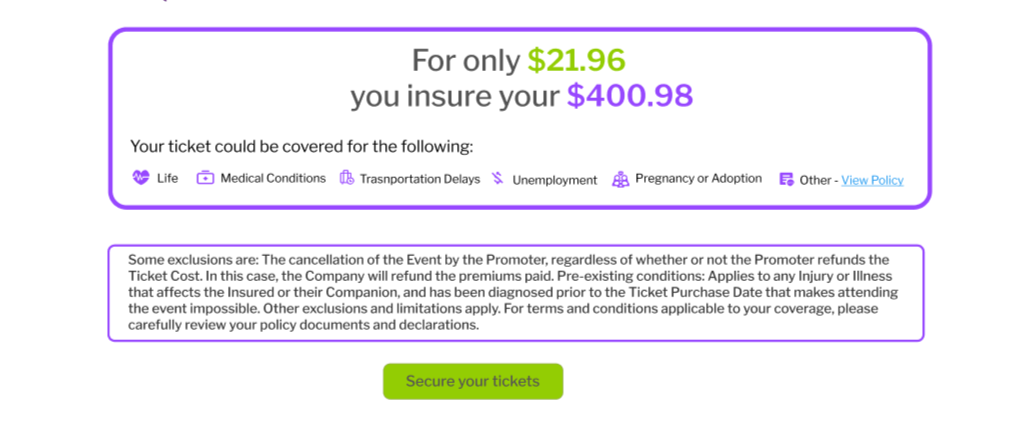
Ticketera was not just an insurance integration. It was a transaction-based growth product introduced at the most sensitive point in the funnel: checkout. The challenge was to create a new add-on revenue stream through partners without adding friction, weakening trust, or disrupting purchase conversion.
The same pattern applies to marketplaces, subscriptions, and live-event platforms: when user intent is highest, the product has to make the value obvious, the decision easy, and the partnership invisible.
The Real Problem
The Challenge
Launching a trust-based product in a live checkout flow required alignment across:
Multiple companies
Compliance constraints
Payment systems
Customer expectations
Any friction or delay risked breaking the core purchase experience.
The Opportunity
Event ticketing created a clear moment of intent, but no safety net. If plans changed, users absorbed the full loss.
The risk wasn’t integration. It was adding friction at the moment of highest intent.
“
The Moment: Intelligence does not scale when embedded locally. Centralizing reasoning as a platform capability reduced duplication, aligned teams around a shared language, and turned fragmented signals into cumulative organizational understanding.
The Strategic Tradeoff
We faced a foundational decision:
OptionA: Delay launch until every scenario was automated
Lower operational risk
Missed market window
Slower partner validation
One low-frequency scenario, automated event cancellation handling, was not fully supported in the first release. The question was whether to delay launch until every edge case was automated, or launch with a controlled manual process and prioritize automation once demand was validated.
Option B: Launch with manual handling for low-frequency cancellation scenarios
Accept limited operational exposure
Validate demand and checkout behavior
Prioritize automation post-launch
We chose Option B, we treated cancellation handling as a scale problem, not a launch blocker.
Blocking launch for a low-frequency edge case would have delayed demand validation and partner confidence at the moment of highest intent.
What that meant in practice:
We prioritized:
Seamless checkout integration
Clear trust messaging
We deferred:
Automated Cancellations
Complex claim adjudication (Handed off to partner)
Multi-event shopping cart support
To reduce risk, we launched a phased GTM:
Soft launch with a single event
Validate flow, messaging, and claims handling
Gradually expand across events
This allowed us to ship while preserving confidence across partners.
Outcome
We validated demand without compromising the core purchase experience. Once trust is broken at checkout, you don’t get a second chance; that constraint guided every tradeoff we made.
Impact:
Launched Puerto Rico’s first ticket protection product
Projected to protect 200K+ tickets per year
Created a new add-on revenue stream for Ticketera and partners
Established a repeatable model for future marketplace add-ons
This created a blueprint for monetizing trust-sensitive moments without degrading conversion
What I’d Do Differently
I would have automated cancellation handling earlier, not because it blocked launch, but because it became the next scale constraint once adoption grew. The initial data validated the decision, but earlier automation would have reduced operational overhead sooner.