Timing is the product.
Three companies, one purchase journey, and no room for the customer to feel the seams between them. The launch was one timing decision and the growth strategy was another. Both came down to the same insight: attention is not won by saying more, but by choosing when to speak.
I led the product end to end, from partner alignment and experience design through integration testing, go-to-market, and launch. It became Puerto Rico's first ticket-protection product.
Three companies had to make the experience work as one. Ticketera owned the ticket-purchasing journey and created an additional revenue stream from enrollments. At Cuvro, we embedded the protection workflow into Ticketera's post-purchase experience. Assurant extended its protection product through a new distribution channel and handled coverage and claims. None of those seams could become the customer's burden.
The central launch decision was how much automation we needed before putting the product into production. One low-frequency scenario (automated handling when an event was cancelled) was not fully supported in the first release. We could delay until every case was automated, or handle those initial exceptions manually while validating the core experience and integrations.
I chose the second option, but not as a full public launch. We introduced the product silently on one event that was already selling tickets. There was no announcement or campaign, and only customers purchasing after the protection workflow went live could encounter the offer.
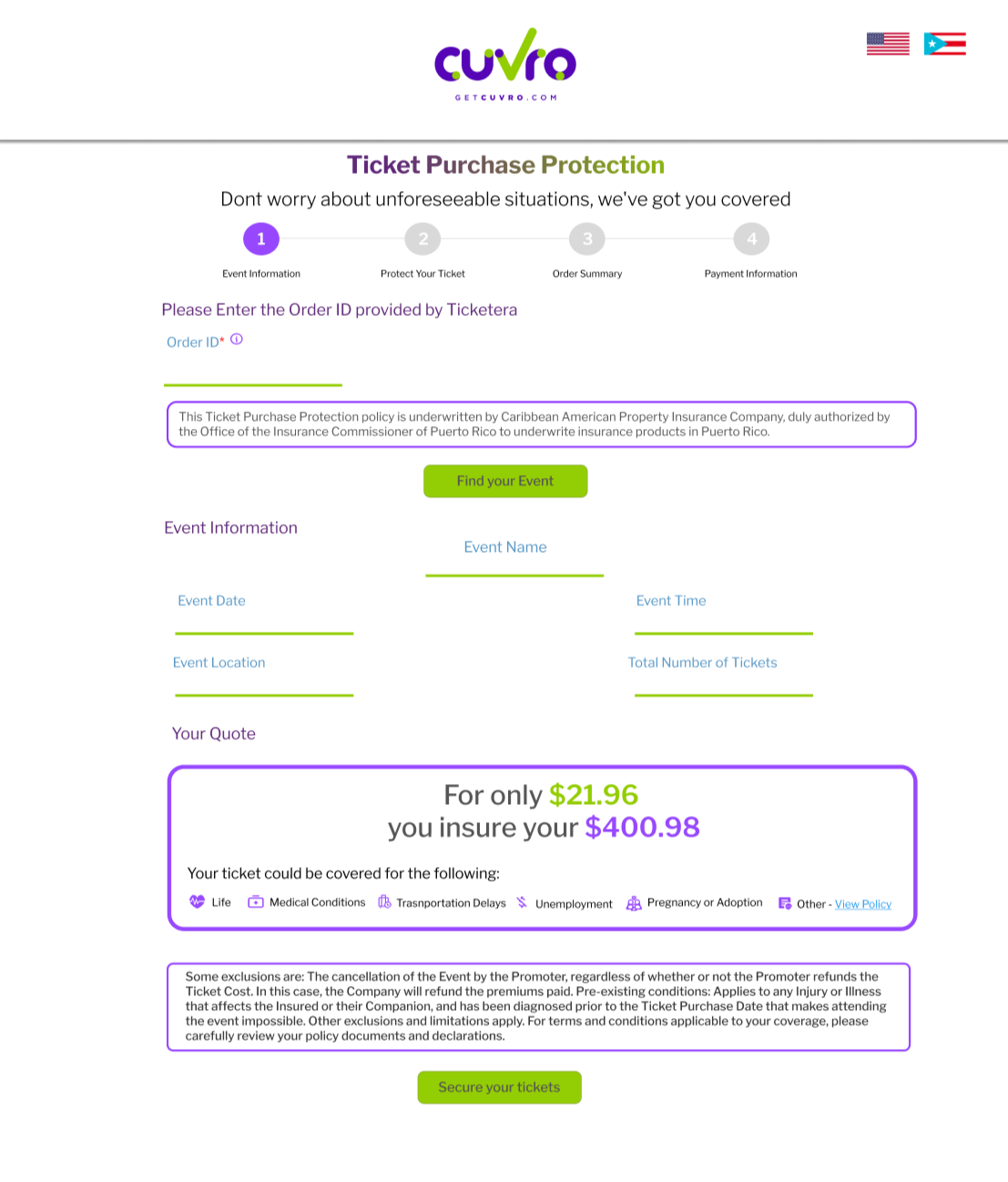

Two design passes on the protection quote flow, refined through partner testing before launch.
Thirty-seven customers enrolled. Because tickets had already been selling before the protection option became available, the venue's 3,100-person capacity was not a valid denominator and we did not treat the result as a conversion rate. The enrollments confirmed that the offer, enrollment flow, partner handoffs, confirmation emails, and protection records all worked in production. They also gave us the first customer data from which to begin understanding who selected protection.
We then expanded event by event, using each release to strengthen the workflow and build partner confidence before increasing availability.
Once exposure increased, experimentation became a growth tool rather than a launch-validation tool. We tested where the offer appeared in the customer journey, how it was explained, and when follow-up emails were sent.
The clearest result came from timing. Customers were more likely to open emails sent closer to the event than messages sent sporadically, when the possibility of plans changing still felt abstract. Adding more explanation was not the primary lever. The message performed better when the reason to consider protection felt immediate.
The product was projected to protect more than 200,000 tickets annually and created a new embedded revenue stream for the partners.
The main lesson I took from this experience was that adoption depends as much on how and when a product enters the customer journey as on the product itself. The silent launch, phased expansion, and later experiments helped us introduce protection at the moment it felt most useful and relevant.
What this involved
- Silent production launch on one already-selling event
- 37 initial enrollments used for workflow validation, not as a conversion benchmark
- Event-by-event expansion after the first production validation
- Later experimentation across placement, timing, and messaging
- Three partners coordinated behind one integrated customer experience
- 200K+ tickets annually in projected protection volume
- End-to-end ownership across strategy, requirements, UI, integrations, compliance, GTM, and lifecycle communication