Memory is the moat.
A nine-figure commercial opportunity was on the line, and the customer had identified what the product was missing. The immediate pressure was to protect Site Sentry's momentum by continuing to ship features. I believed the missing capability belonged above any single product.
I originated Orbis and led the product vision and technical strategy that moved it from an unfunded concept into the shared memory and reasoning layer for the AI Applications portfolio.
Site Sentry could detect and organize change. Orbis would give the system enough memory to interpret that change.
I created a rapid interaction mockup showing the experience: a user opened a monitored location and immediately received a summary of what had changed and why it might deserve attention. From there, the user could ask follow-up questions without reconstructing the location's history or their priorities every time.
Early mockup, used to pressure-test the idea with engineering and later to secure stakeholder approval for the first engineer.
I brought the concept to engineering first to test whether the approach was technically feasible. I then presented the product vision, prototype, and validation strategy to the CTO and VP of Product. I was not asking them to fund the full platform yet. I asked for one full-time engineer, one part-time front-end engineer, and two weeks to prove the concept using Site Sentry's existing infrastructure and real data.
Two weeks later, we had implemented the core experience in Site Sentry's existing codebase using real data. It was not a disposable prototype; it became the foundation for continued product development. The conversation changed from whether the idea was worth pursuing to how we would extend it across the portfolio.
The next architectural decision was how to extend that context beyond one implemented experience. I defined a portfolio-scale approach that combined semantic and episodic memory through a shared ontology connecting historical baselines, new imagery, third-party signals, previous interactions, and user priorities.
The architecture was designed to support summaries explaining what had changed and why it might matter, continuity across follow-up questions, discovery of other monitored locations with similar conditions, and recommendations about what deserved attention next.
Because the platform served multiple customers, memory also had to remain private. Customer data and interaction history stayed isolated in a database-per-tenant architecture. The shared ontology gave each tenant's information a consistent structure for reasoning, while the isolation model prevented information from crossing customer boundaries.
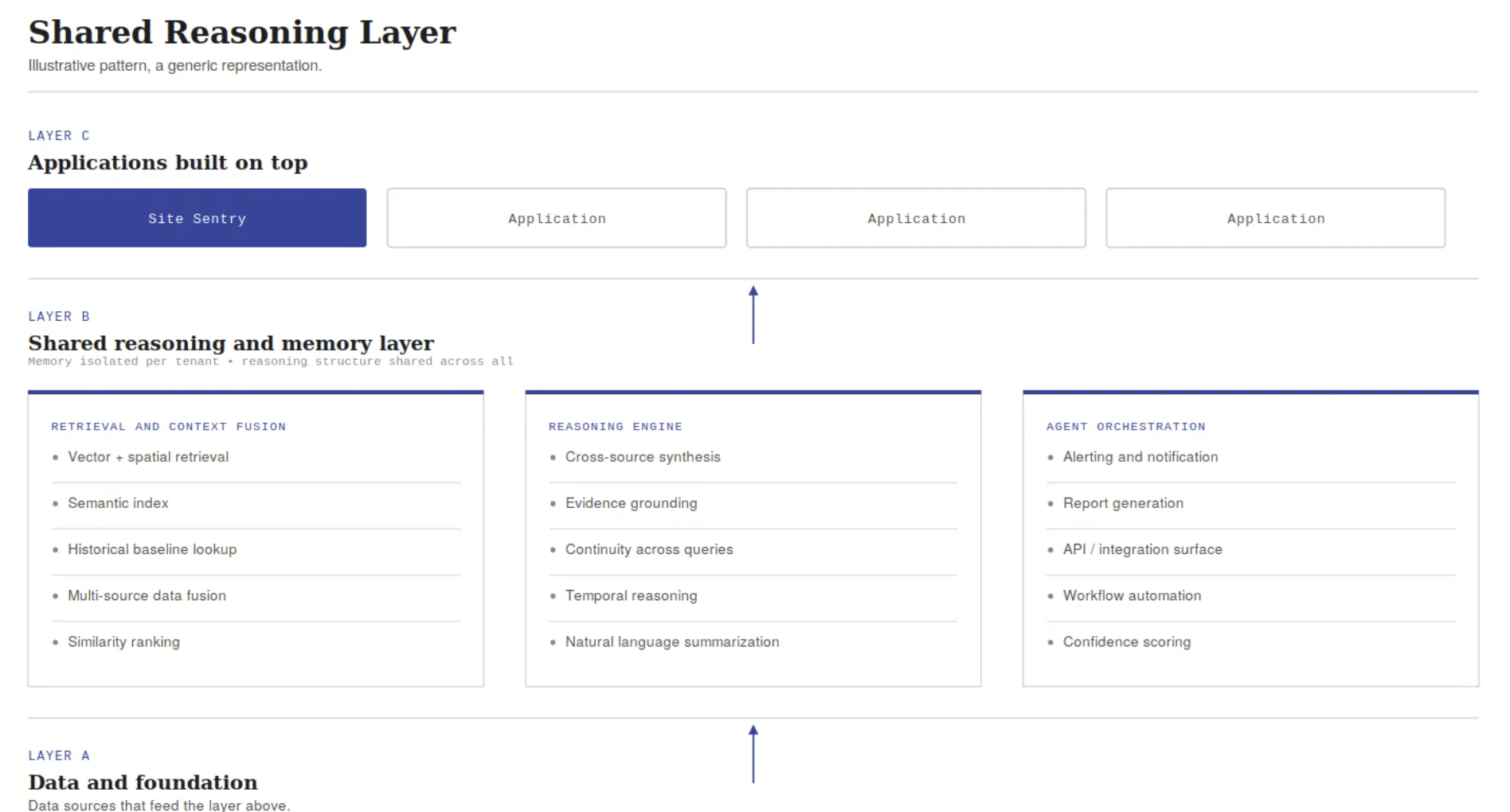
Systems Design: illustrative AI architecture showing memory and context reused across applications instead of rebuilt for each one.
A reasoning layer also required a different quality bar from traditional search. Every summary and recommendation had to remain grounded in its underlying evidence. Users stayed in the validation loop and could confirm or correct what the system surfaced, allowing their judgment to inform the context carried into later interactions.
Orbis reduced time to insight from six to eight hours to under fifteen seconds and reduced duplicated development across products by approximately 25–30 percent. Site Sentry had generated a $145 million sales pipeline. When we began demoing Orbis as the shared context and reasoning layer, that pipeline expanded to approximately $300 million.
The lesson was not simply that memory improves an AI product. Memory changes what the product can be. Without it, every interaction begins from zero. With it, the system can summarize, recommend, and help users discover what matters next.
Storyline - Site Sentry: featured on Google Cloud's blog, which described the application as turning aerial and satellite imagery into "actionable insights," helping teams identify damage and prioritize repairs after events like storms.”
What this involved
- Working implementation in 2 weeks using the existing codebase and real data
- 6–8 hours → under 15 seconds in time to insight
- $145M → approximately $300M pipeline after Orbis was introduced in customer demonstrations
- 25–30% reduction in duplicated development across products
- Semantic and episodic memory connected through a shared ontology linking locations, events, signals, and user context
- Evidence-grounded AI outputs with people retained in the validation loop
- Database-per-tenant isolation protecting customer memory and interaction history